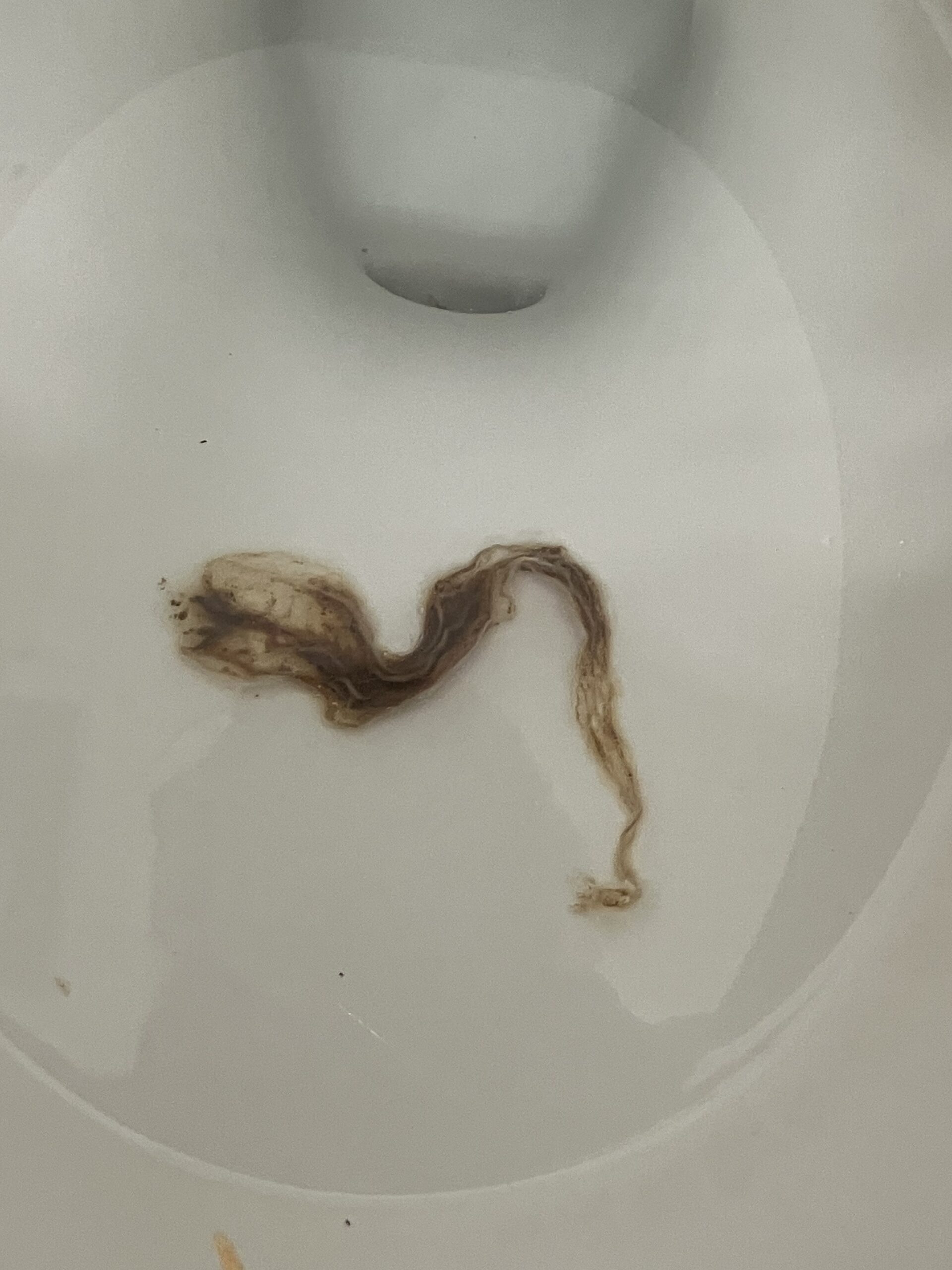
On February 22, 2017, I looked down into the toilet and saw a seven inch, mucus covered parasite twisted like a piece of wet rope. Since then I’ve done over a thousand enema sessions and seen thousands of feet of Rope Worms come out of my body. Some were over twenty inches long, and as they came out, I got healthier and healthier.
So when people ask me, “Are rope worms real?” I think it deserves a better answer than the one Google gives you.
What the First Page of Google Says
Search “are rope worms real” and the top results all say the same thing. Wikipedia calls them pseudoscience. Healthline, Cleveland Clinic and Science-Based Medicine say they’re most likely intestinal mucus, shed gut lining, or undigested food.
Most people read the first three results and stop there. But read those articles closely and you’ll notice something. Not one of them reports testing a single specimen. They cite the same 2013 paper, they cite each other, and they repeat the same conclusion. That’s an assumption that got repeated until it sounded like a fact.
Where the Idea Came From
The term “rope worm” comes from Dr. Alex Volinsky and Dr. Nikolai Gubarev. In 2013 they published two papers describing what they believed was a new human intestinal parasite, which they called Funis vermis. They described five stages of development, from slimy mucus to a twisted, rope-like body that can grow over a meter long.
Those papers were self-published online and not peer reviewed. Skeptics point that out constantly, and it’s true. But in the thirteen years since, nobody has done the follow-up study.
What the DNA Actually Showed
The skeptics’ favorite argument is DNA. Volinsky’s paper tested specific “barcode” genes scientists use to identify species, and those came back about 99% human. Critics say that settles it. If it’s your DNA, it’s part of you.
That’s only half of what the paper found. When the researchers sequenced the specimen’s DNA more broadly, less than 10% of it matched human or bacterial DNA. More than 90% matched nothing known. The authors called the results inconclusive.
If these were simply shed intestinal lining, you’d expect most of that DNA to match human tissue and the gut bacteria that coat everything in there. It didn’t. Skeptics will say the unknown DNA was poor-quality data or gut microbes that hadn’t been catalogued yet. Maybe. But nobody has gone back to find out. “It’s just mucus” has never been proven. It’s been assumed.
Five Holes in the “Just Mucus” Story
1. The gut is still largely unmapped. In 2019, researchers published a study in Nature identifying nearly 2,000 bacterial species in the human gut that science didn’t know existed. That expanded the known diversity of gut bacteria by 281%. If we were still discovering thousands of new species in the gut in 2019, how confident should anyone be that they know exactly what every strand coming out of it is — without testing it?
2. Standard parasite tests miss things. The test most doctors order is the stool ova and parasite exam. The CDC recommends three or more samples collected on separate days, because one sample often isn’t enough. One clinical review estimates a single specimen recovers only about half of intestinal parasites. Most people get tested once. And that test is designed to find known parasites and eggs under a microscope. It was never built to look for something like a rope worm.
3. “The cleanse makes rope worms” doesn’t explain my experience. Skeptics often say the products themselves such as clays, psyllium, fiber, herbs actually form the ropes. My first rope worm came out after taking food grade diatomaceous earth with no enema at all. Since then, the majority of mine have come out with enemas and I have removed 1000s of feet of them! The more I got out, the more my health improved and my ailments faded. And as my health improved, the rope worms got fewer and fewer, even though I kept doing the same protocols. If the enemas were making them, why would they slowly disappear?
4. Medicine has been confidently wrong before. For decades, doctors were sure stomach ulcers were caused by stress and excess acid. In 1982, two Australian researchers, Barry Marshall and Robin Warren, said a bacterium was the real cause. Marshall was dismissed as an upstart pushing a hypothesis with no credibility. In 2005 they won the Nobel Prize, and that bacterium, H. pylori, is now standard medicine. “Everyone agrees” and “it’s been proven” are not the same thing.
5. Nobody makes money finding out. Serious research costs millions of dollars, and it’s usually funded by someone who expects a return. You can’t patent an enema. You can’t patent mimosa pudica seeds or water. There’s no product to sell at the end of a rope worm study, so the study doesn’t get done — and people with real symptoms keep getting told it’s all in their head.
It’s Not Just Me
If this were one guy’s strange experience, I’d understand the eye rolls. It isn’t.
Thousands of people in online rope worm communities report the same thing I do: years of unexplained symptoms, negative test results, then rope worms coming out after enemas, and other parasite removing protocols, followed by much improved health. I’ve coached many clients who’ve gone through it. Some were sicker than I ever was. Some came in fairly healthy and just wanted answers about what they were seeing. Many describe the same pattern: symptoms ease after the ropes come out.
Anecdotes aren’t proof. I know that. But when thousands of people independently describe the same thing, the right response is to study it. Not to dismiss it!
My Experience, in Short
Before discovering rope worms, I tried everything: two parasitologists, prescription antiparasitic drugs, black walnut, wormwood, clove, oregano oil, colloidal silver, fasting, acupuncture, Chinese herbs and a lot more. Very little changed. At one point, I dropped down to 129 pounds while eating 3000 – 4000 calories a day. I had an allergy to cold that caused hives over my whole body, constant bloating, belching, canker sores, joint pain, insomnia, emotional disturbances, brain fog and more. In 2011, I had emergency surgery to remove six inches of my small intestine after it twisted and died, and the surgeon never found a cause.
After I started regular enemas and rope worm cleansing in 2017, the ropes came out and my symptoms started to fade. When I waited too long between cleansing sessions, the symptoms came back. At first I had to cleanse multiple times a week. Over the years, the gaps got longer and the ropes got fewer. Today I’m at a steady 155 pounds, My allergies are gone, the canker sores, insomnia and digestive issues have faded and I rarely get sick!
The Bottom Line
I believe rope worms are living organisms that don’t belong in the body. I can’t prove it with science but the people who say they’re “just mucus” can’t prove that either and they’re the ones claiming the case is closed.
The honest answer is this: one inconclusive study, no follow-up, more than 90% unidentified DNA, an evolving field of gut research that continues to discover new species, standard tests not designed to find it, and thousands of people reporting the same experience. That’s not a debunked myth. That’s an open question science has bothered to answer.
Are rope worms real parasites? Science hasn’t answered that question and it’s barely asked it. Don’t let the first three Google results do your thinking for you. Look at what’s actually been studied, what hasn’t, and what your own body is telling you.
I go much deeper into rope worms, biofilm and every cleansing method I’ve ever tried in my book, Rope Worms: BIOFILM, PARASITES, and the HIDDEN CAUSE of CHRONIC ILLNESS, available on Amazon.
You can also read more about my story or schedule a coaching call with me.
This post reflects my personal experience and is for educational purposes only. It is not medical advice. I am not a doctor. Please talk to a qualified healthcare provider before starting any cleanse or protocol.